What does the full report include?
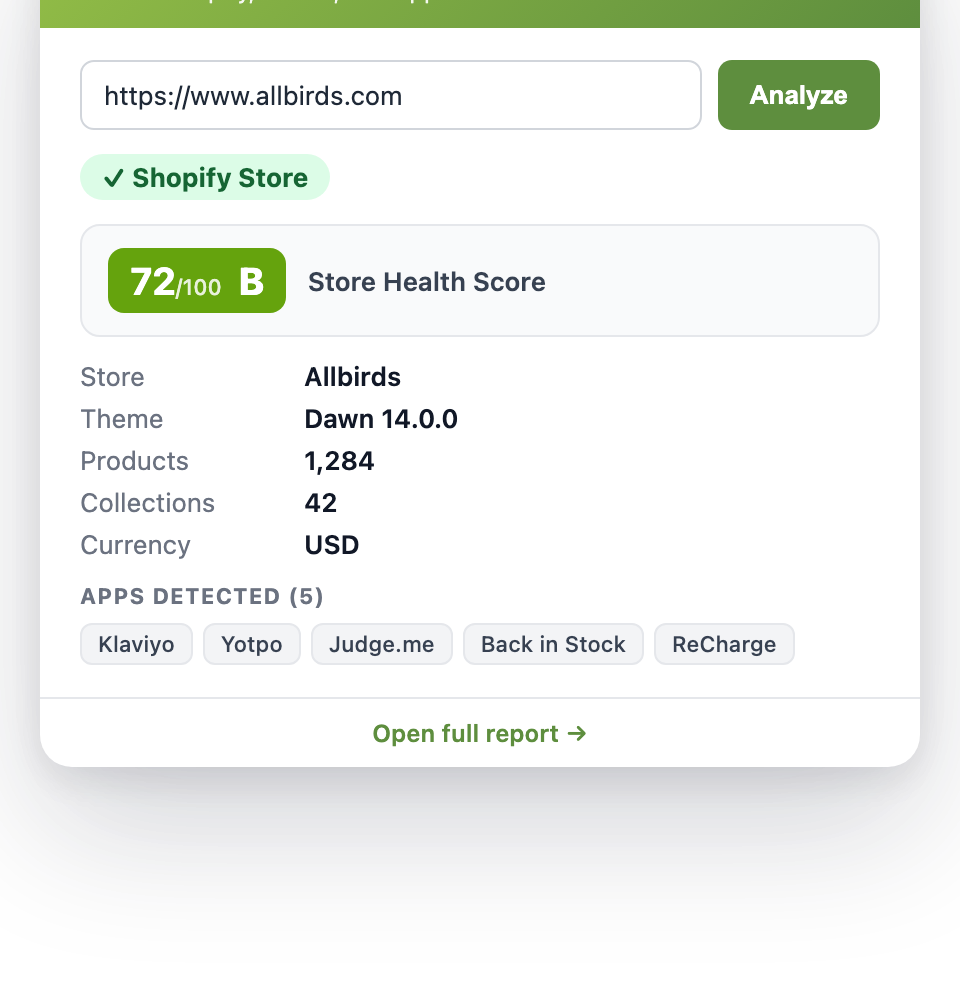
The report includes Shopify verification, theme, apps, product count, collection count, store metadata, public schema signals, robots/AI crawler checks, and recommendations.
Get a full breakdown of any Shopify store — theme, installed apps, products, collections, and more. Instant results, no API key required.
Paste any store URL. No login required.
The store analyzer combines theme detection, app signatures, product and collection counts, store identity, SEO/AEO checks, public tech signals, and related research links.
The report includes Shopify verification, theme, apps, product count, collection count, store metadata, public schema signals, robots/AI crawler checks, and recommendations.
Yes. It gives a quick read on how a store is built, which apps support conversion, and how large its public catalog appears to be.
No external scanner can see private admin data, revenue, or exact inventory. This tool is a fast public-data audit and starting point.
Open focused tools for products, variants, sitemap, policies, myshopify URL, country, currency, and product search based on what the report reveals.
Install the free extension to run the same report on the store you are viewing.
Works on Chrome, Edge, Brave, and other Chromium browsers.
Paste a URL, run the scan, and review the report.
Enter any public store domain in the search box.
The tool reads public storefront signals.
See the theme, apps, products, and collections in one place.
A clear report with the most useful public store signals.
Shows the public Shopify theme name when the store exposes it.
Lists popular apps detected from public storefront scripts.
Confirms whether the website appears to run on Shopify.
Counts visible products from public Shopify catalog data.
Counts public collections when the store makes them available.
Stores recently checked with our free theme & app detector. Click any to re-run the analysis.
 weathernews.myshopify.com
The themes most frequently detected by visitors using this tool.
Quick answers about the detector.
Enter the store URL into our free Shopify theme detector above and click Analyze. The tool reads the Shopify.theme JavaScript object embedded in every Shopify storefront and returns the exact theme name instantly — no login required.
Our tool is one of the most accurate free Shopify theme detectors available. It uses multiple detection methods — including the Shopify.theme JavaScript object, data-theme-name attributes, and meta tags — to identify the exact theme. It also detects 65+ apps, product counts, and collections, all with no account or API key needed.
The theme detector checks four signals: the Shopify.theme JavaScript object embedded in every storefront, the theme name in script tag attributes, data-theme-name HTML attributes, and meta tags. This multi-signal approach gives accurate results across virtually all Shopify stores.
Yes. In addition to theme detection, the tool scans the store's public HTML for known app script signatures and detects 65+ popular Shopify apps including Klaviyo, Yotpo, Judge.me, ReCharge, Loox, Gorgias, Klarna, and more. Backend-only apps that do not inject frontend scripts will not appear.
Yes, completely free. No account, no API key, and no credit card is required. Just enter any store URL and click Analyze to detect the theme, apps, and more.
The detector checks multiple signals: references to cdn.shopify.com, the Shopify.theme JavaScript object, myshopify.com domain references, and whether the store responds to Shopify's standard /products.json endpoint.
Yes. The tool uses Shopify's public /products.json endpoint to paginate and count all visible products. For stores with 5,000+ products it displays the count with a plus indicator.
Some Shopify stores enable password protection during development or maintenance. The detector can still confirm it is a Shopify store and often detect the theme, but app detection and product counts may be limited.
Partially. Headless Shopify stores use custom frontends so theme detection may not work. However the /products.json and /collections.json endpoints are usually still available so product and collection counts will display.